First Experience in Nanhua
In the Nanhua community, aside from learning about its geographical location and industrial characteristics, through teaching discussions with resident physicians and conversations with health center staff, I gradually came to understand local issues such as population aging and labor outflow. The social issues constantly described in textbook form during high school are now vividly presented before my eyes, allowing me to personally experience the mission and helplessness of frontline grassroots personnel.
Traveling back and forth to Nanhua multiple times, we were fortunate to be driven by a senior resident physician, sparing us the exhaustion of travel. However, on one occasion due to scheduling conflicts, we had to take public transportation ourselves, spending nearly two hours in a packed, bumpy bus like sardines. It was then that I deeply felt the preciousness of medical accessibility in urban Tainan and the inconvenience of seeking medical treatment in rural areas. In the Nanhua area, the health center serves as the first line of medical care, handling important local public health duties such as vaccinations and chronic disease tracking and control. The adjacent fire department's ambulance can, if necessary, immediately transfer acute and critical cases to the Xinhua Branch Hospital, and only then to National Cheng Kung University Hospital.
Home Visits
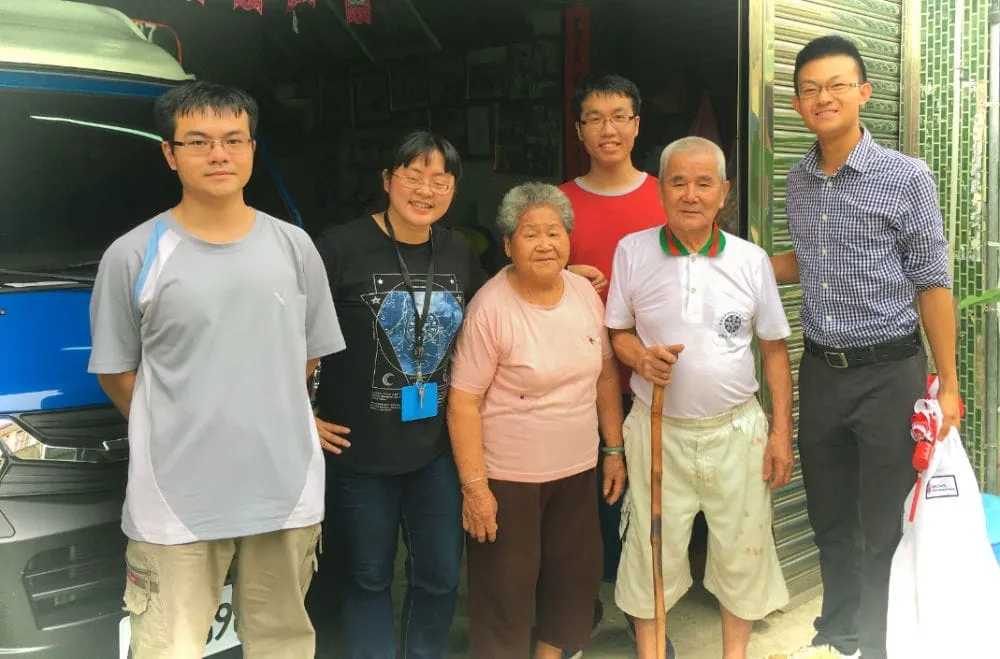
One very memorable experience was the home visit. The subjects of the home visit were a family very common in the Nanhua District: elderly parents in their empty nest phase, living idly at home. As we followed the map and chatted in halting Taiwanese according to the home visit questionnaire, we were surprised to find that the interviewed grandfather and grandmother did not have any social functional disabilities. Aside from the grandfather needing his children to drive him to National Cheng Kung University Hospital for follow-ups due to a minor stroke and a cardiac stent, both elders could walk to the health center for medical treatment on their own. They also actively participated in community activities such as karaoke competitions and volunteered at community care centers. Their sons and daughters also returned frequently to visit. However, if someone were to become bedridden, related care needs and burden issues would emerge, making the subsequent situation quite worrying.
Administrative Situation
Aside from general duties, what more can the health center do in Nanhua? Because the Nanhua District is close to the mountains with many mountain roads, making transportation inconvenient, there is a desire to maximize medical accessibility. Therefore, the health center conducts mobile medical clinics in Guanshan Village, with the health center director personally taking a vehicle along with accompanying nurses and pharmacists to see patients there. Additionally, one could consider leveraging the power of important regional gatherings or religious activities. For instance, Nanhua Village has the Tianhou Temple as a gathering hub; could health education campaigns be conducted there? Because a higher proportion of the elderly in the Nanhua area missed out on early education, the design of health education flyers or posters must take this into account. Only by making good use of neighborhood activities and the power of word-of-mouth is there a chance to deeply root important medical concepts in people's minds. However, facing the macro-environmental trend of young and middle-aged labor outflow and a scarcity of care resources, this aspect may still require seeking assistance and planning from higher-level authorities.
Because there are subsidies from reservoir conservation area compensation funds, many people are registered in Nanhua but do not actually live there. This causes administrative troubles for the health center, such as tracking the status of newborn vaccinations. Under pressure from higher-ups, the health center bears the responsibility of monitoring the vaccination rate and will even go to homes to evaluate vaccinations when necessary. Once, the head nurse took us over the mountains to a low-income family that had been repeatedly notified for vaccinations but consistently failed to show up. Because all three children in the family had developmental delays, the head nurse's face was filled with worry. The children outside in the courtyard were bouncing around; inside the house, while I amused the children and conducted developmental assessments, I thought about the urban-rural gap and balanced regional development. Higher government authorities constantly talk about improving these predicaments, but how many people stand on the front lines bearing endless heartache like the grassroots personnel of the health center?
Regarding Long-Term Care
In various teaching discussions, Dr. Chih-Hsing Wu shared his thoughts with us regarding the authorities' long-term care policies. Locally in Nanhua, after the Long-Term Care 2.0 policy began to be promoted, the district office started coordinating through the Social Welfare Section, planning to expand and strengthen the original meal-provision care centers to meet the Level A, B, and C grading structure in the Long-Term Care 2.0 plan. However, official documents sent to higher authorities have continuously met with no response, and funding has not been allocated. Regarding the promotion of Long-Term Care 2.0, the health center, which should be the directly affiliated institution, has received absolutely no news in this regard, revealing a situation of conflicting policies and unequal information. And while writing this report, I also heard that the Ministry of Health and Welfare will separately establish a Department of Long-Term Care to coordinate long-term care policies. Yet, the emperor is far away; officials sitting in offices set ideal performance goals based on written theories and statistics, but they will not tell the grassroots level exactly how to implement them. When the grassroots level cries out to heaven and earth with no answer, the ideal vision of the Long-Term Care 2.0 policy can only struggle along, fighting while trapped in the mud.