For me, a review of 2023 could be summarized in just a few words, but that doesn't mean it isn't worth writing about. Passing the doctoral qualifying exam might be a turning point. The challenges of taking courses this semester, along with the Ph.D. candidate title earned after passing the finals, could also be memorable parts of 2023.
But the focus of this article is not on detailing those events, but rather on examining what constitutes true change and growth.
The Interaction Between Health and Psychology
In the first half of 2023, my mind was entirely focused on the doctoral qualifying exam and finding a stable income to get by. Looking back now, with a weak body and mind, there wasn't really much growth.
Starting in the second half of the year, following my original plan, I started going to the gym and hired a coach to supervise my weight training. Fortunately, there are gyms within five hundred meters of both my workplace and my home.
During my fitness training, the thing the coach most frequently singled out to supervise was the impulsiveness in my movements.
For every movement, I just desperately wanted to complete the specified number of reps and quickly maneuver the equipment to the designated position, but the completeness and correctness of the movement were often neglected.
So the degree to which each movement actually trained the muscle was compromised; a rushed finishing motion also hurts the joints and muscles, which will accumulate over time and turn into long-term sports injuries.
But the "impulsiveness" in these movements also feels related to the interaction between my long-standing psychological state and my upbringing environment.
When interacting with the outside world, hearing loss—coupled with the delay in language processing speed training due to not wearing hearing aids early on—makes my reactions a beat slower.
This anxiety of failing to keep up with the outside world's reactions is already deeply engraved in my bones, and my gradually deteriorating visual field, lacking proper psychological cognitive construction,
only deepens this further.
Before starting the fitness plan, I was vaguely aware of this. And during the execution of fitness movements, through feedback from others and the most direct feelings of my body,
I became even more determined that I must improve looking "impulsive."
Focusing on the completeness of every movement during fitness training is also a mirror for myself.
How to breathe properly, how to stretch and tighten the muscles well, and how to properly control the position of the equipment—
besides the physical training itself, these are also rehabilitation for a soul that was once overwhelmed to the point of breathlessness.
If there has to be a conclusion, it is that
I still have to work hard, but the true goal of my efforts,
Is not pursuing perfect external reaction speeds,
But pursuing the calmness, composure, and leeway coordinated jointly by the body and mind.
Sleep
My sleep is an absolute disaster.
The uncontrollability of my sleep state is also likely the fundamental reason why I had to leave the hospital.
Because I cannot guarantee that my mind will remain completely clear during working hours.
No matter how I adjust, no matter what work situation I am in (unemployed, working full-time, or working part-time during the week),
my mental state in the morning is invariably worse; it feels as if something hasn't completely woken up.
I've gotten used to forcing myself into a working state with a cup of black coffee.
And if I am busy all week, there will definitely be one day where I need to sleep until noon just for the mental fatigue to ease.
It is indeed related to sleep quality; if the previous night's sleep quality is very good, the morning grogginess improves.
But it seems a night of perfect sleep quality is unattainable.
Currently known alleviating factors are:
- Strong sunlight exposure in the morning.
- Avoiding caffeine intake in the afternoon, or only drinking weak green tea.
- A cooler ambient temperature when falling asleep.
- Small doses of SSRIs and BZDs seem to offer some improvement.
The hospital environment is cold. Under the old air conditioner at home and a house rule that the AC is only turned on when it exceeds 27 degrees Celsius,
I spent at least two years working in cold temperatures during the day and returning to high temperatures at night. This may have worsened my sleep quality.
During the preparation for the doctoral qualifying exam, this severe groggy state did not completely disappear despite leaving hospital work.
After passing the qualifying exam and starting the fitness plan, there was some improvement, but not as much as I had expected.
I briefly went to a psychiatric clinic and took SSRI and BZD medications, feeling some improvement, but when I got too busy and forgot to return for follow-ups, I didn't get refills.
I suspect that the genetic defect in USH2A might have effects that are currently unknown on melatonin or the pineal gland.
Furthermore, an almost completely degraded retina is indeed discussed in literature as being associated with the regulation of circadian rhythms.
So... there really doesn't seem to be much I can do to improve my sleep quality... tragic.
Now, I can only take things one step at a time.
At least, through over a year of recuperation, I can naturally wake up around 8 or 9 AM.
Family
The meaning of family to me is actually very complex; to me, it is a mire I cannot break free from.
On one hand, I believe that for a person to be mentally independent, they should move out from their parents and live on their own.
Even renting in another city and working alone would be fine, so that my social life and privacy can have their own space.
On the other hand, my mother seems extremely unwilling to see all her children leave, even if she doesn't say it explicitly.
But from the emotions she arbitrarily spills and vents, I read a fear of being abandoned and having no one to accompany her.
And so I became the only child left at home.
And indeed, when crises occurred at home a few times, they were handled promptly by me staying at home and my sister who was nearby.
In the closed storm of the family, the only thing I can do is perhaps to earnestly cultivate myself,
in order to maintain the autonomy and stability of my emotions and judgment.
The Meaning of Life
Currently, I do not have a strong sense of identity.
There are no values I absolutely must protect, nor life goals I absolutely must achieve.
The obsession I fought tooth and nail for in the past—looking back, who was it for? Who instilled this obsession?
Was it the product of many values pursuing an external image, self-hypnotized heroism, and pandering to multiple expectations?
Was it a constant amalgamation of the images of all the successful people I had seen?
Also, are many of my implicit emotions
derived from the relative sense of deprivation regarding the life experiences of many normal people?
If I see clearly that no matter how hard I try, these life experience opportunities—lost as my eyes gradually go blind—cannot be recalled,
then what was the meaning of the effort driven by that burst of energy in the first place?
I still don't know the answer to this question.
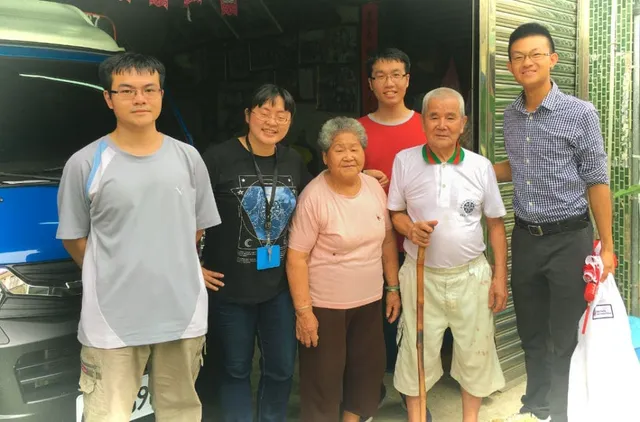
Now, pushing forward the Taiwan Usher Syndrome and Audiovisual Impairment Association is what the professor who originally helped me find the pathogenic gene mutation
came over to pull me into.
She said she couldn't bear to watch my eyes continue to worsen,
and there are indeed many areas in biomedical science, drug R&D, and even IT accessibility
where efforts can be made.
But this thing called my future has never had a clear bottom.
Many things I previously tried so hard to grasp would slip away through my hands like sand.
Yet during this period of rest and recuperation, there are many connections that I inadvertently run into just around the corner.
My New Year's outlook for 2024, my current wish,
is to continue these good connections, keep looking forward, and wait to see what else lies ahead.