Previously, by chance, I learned about the Kindle e-book reader released by Amazon and had been constantly considering getting one from abroad. On one hand, due to eye conditions, E-ink electronic paper technology can indeed reduce the strain on eyes exposed to 3C products; on the other hand, the lightweight and portable nature of e-book readers also attracted me. However, ordering a Kindle in Taiwan required ordering from abroad, which is more troublesome, and the level of support for Chinese was unknown. So I held off on placing an order.
It wasn't until this year, seeing the Readmoo e-book platform crowdfunding to launch the "Mooink e-book reader," that a good option supporting Chinese layout and fonts was finally provided. Additionally, after briefly browsing the library of the Readmoo online bookstore, the sources and quality of the books were acceptable, so I was tempted and pre-ordered it.
On the eve of the typhoon striking on July 29, 2017, I joyfully received the package in my dorm, leading to this unboxing article.
E-ink electronic paper technology has the advantages of saving power, reflective illumination, and being flicker-free.
Packaging
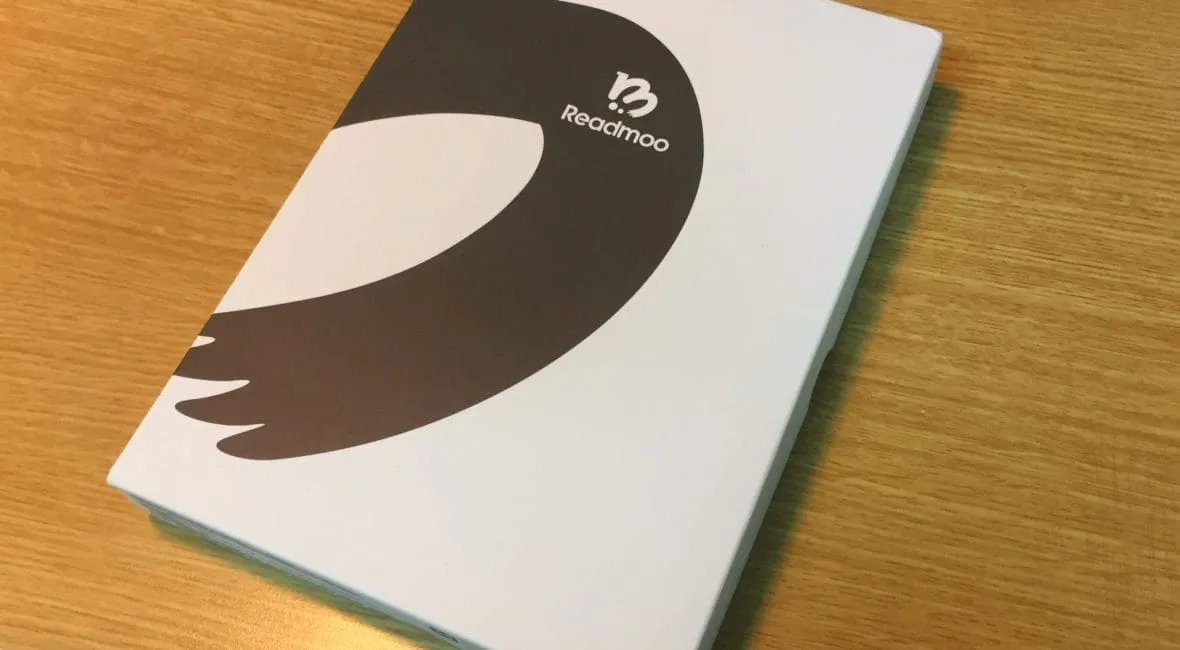
This is the packaging I received with the physical item, featuring an artistic and minimalist design. Since it is a crowdfunded pre-order version, I don't know if it will change when officially launched.
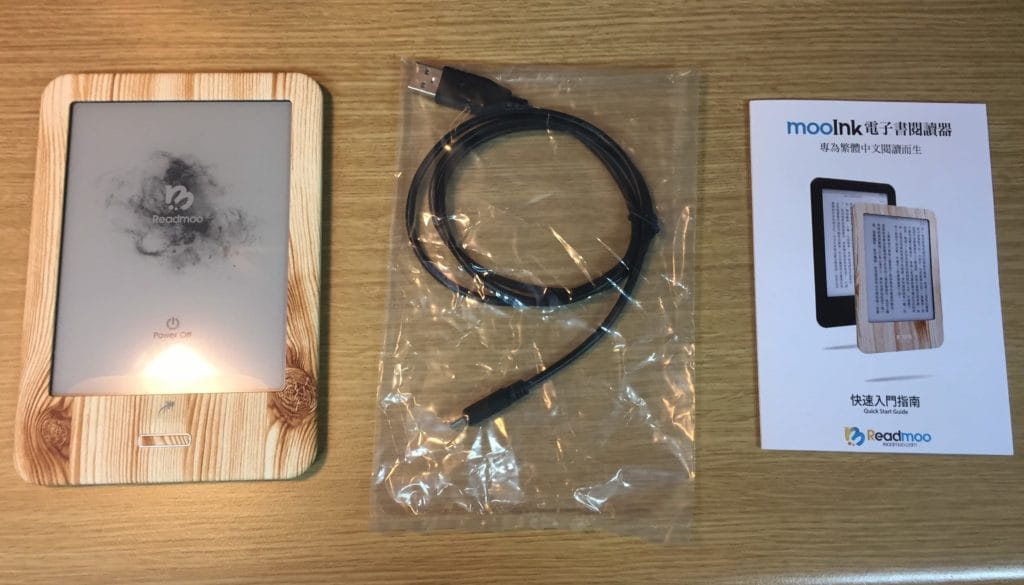
The contents are very simple. In an era advocating environmental protection and no waste, there is only the main unit, a connection cable, and a quick guide. Since many features are still under development, it's unknown whether files can be transferred from a computer to the reader in the future. What is currently confirmed is that documents can be uploaded and synced after logging into an account on the Readmoo website, as well as reading files from an SD card (still under development).
The Product Itself
After the product starts up, it will first request a connection to a Wi-Fi access point. To simplify the system, it cannot connect to Wi-Fi networks requiring browser authentication, such as CHT-WIFI, iTaiwan, and campus Wi-Fi.
The first startup requires a system update. From the system update and part of the system settings, it can be seen that the reader's operating system is modified from Android. Driven by vanity (no joke), I paid extra to order the wood grain version. The wood grain casing feels very comfortable to the touch. With a size of only six inches, it is extremely light; even holding it in one hand poses no burden, and it is even lighter and more compact than many physical books.
Usage
In terms of usage, one can connect to the Readmoo e-book platform to log into an account. After syncing, books purchased for the bookshelf under the account will automatically be listed and can be clicked to download as needed. Alternatively, it can also read documents uploaded via a browser on the computer side, supporting EPUB, DOCX, TXT, and PDF. As for reading, as shown in the picture above, there is no harsh backlight stimulation. It displays entirely based on the black-and-white electronic paper technology. Tapping left or right can turn the page, while tapping the dead center can bring up options to change line spacing, font, font size, brightness, horizontal/vertical layout, etc., as well as the outline and book information. Supported fonts include Xin Gothic, Source Han Serif, DFBingMin, DFBingFangSong, and DFBingKai. It does not support readers importing fonts themselves, but it's unknown whether more fonts will be opened up in the future.
Since it is just an e-book reader with simple functions, do not expect it to have the same performance and smoothness as an iPad. When turning pages, you will see a temporary black afterimage flash as the e-paper refreshes. Currently, a direct entry to a browser cannot be found, which might make reading web novels slightly inconvenient. However, within the reading interface, you can long-press to highlight and select vocabulary, and jump to web searches. So it should be capable of browsing the web.
Because it uses e-paper technology, the reader only consumes power when the screen refreshes. The manufacturer designed the interesting screen shown above for when it goes to sleep.
Conclusion and Thoughts
Besides the reader hardware, one actually cannot ignore the overall setup and operation of the platform software. By the time I came across the crowdfunding news for this e-book reader, Readmoo had already integrated publishers, websites, cash flows, etc., presenting the appearance of an ambitious content provider. This ambition is reflected not only in the integration of hardware and software but also in the effort to perfect details. When I explored syncing methods on other platforms, I unexpectedly found that in addition to mobile devices, the reading client program had also been developed for the minority group using Mac OS X. With a continuously active publishing ecosystem and a convenient operational experience, users will naturally be more willing to trust future support and build customer stickiness, forming a virtuous cycle.
On the afternoon of a typhoon day-off that was almost canceled on Monday, while waiting for classmates to process school-leaving procedures, I read half a book. I sincerely recommend this device to those who, amidst a busy pace, are struggling to regain the joy of reading. I also hope the Readmoo platform can grow stronger and attract more great titles onto the platform.

![[Unboxing] - Power Donut: A Portable Power Strip with Ingenious Design](/_astro/IMG_0137-1180x650.BOP_ghvP_ZuEWtE.webp)