I feel that in this film, the director excels at using unspoken details to illustrate the themes she wants to convey, or to present contradictions and questions for the audience to ponder.
For example, regarding the medical profession, it seems the prevailing impression has focused on highly stable income and the pursuit of profit. The detectives' dialogue at the beginning, when the doctor first goes missing, inadvertently reveals this. When the three daughters of the kind mother (I'm sorry, I forgot her name) return, the somewhat jealous and sarcastic remarks from two of them reflect this as well ("He makes two digits more than we do... I heard he's supporting a younger man...").
One evening, Soma's sincere admiration for Dr. Ino reveals his strong dissatisfaction with his own father, who cares only about the hospital's financial revenue. This perfectly mirrors modern society's skepticism toward cold, self-interested, profit-driven doctors, as well as the physician's inherent conflict between a compassionate desire to save lives and the pursuit of income.
In this remote rural village, the director bears witness to the preciousness of a warm, trusting doctor-patient relationship through the police interrogations, the interactions between the doctor and villagers, and the worshipful words of Soma during his internship. However, this doctor-patient relationship becomes profoundly ironic when everyone later discovers that Dr. Ino is a fraud.
While watching this film, another thought came to mind: the true thoughts in everyone's heart are not always fully understood by those interacting with them, and as an audience, we sometimes find it hard to guess and interpret as well.
On the night of the pneumothorax patient incident, after successfully treating the patient, the nurse returned to the kitchen, collapsed onto the floor, and panted heavily. What was going through her mind with those wide-open eyes? Was it simply the relief of immense pressure? Or was she beginning to doubt the doctor? When Soma passionately declared that he wanted to become a rural doctor like Dr. Ino, did he truly listen to what Dr. Ino said in response? Under what conflicting emotions and pressures did Dr. Ino tell this hopeful, legitimate medical student—who looked at him with such reverence—"I am not a doctor"?
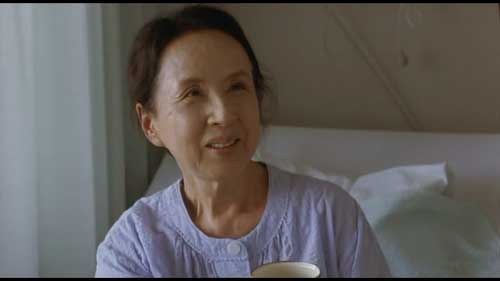
The interactions between Dr. Ino, the mother suffering from cancer, and her daughter are also very subtle. The mother went through immense hardship raising her three daughters but endured her pain silently, afraid of being a burden to them. It wasn't until Dr. Ino appeared that she felt safe enough to entrust him with her care, and a bright smile that hadn't been seen in years bloomed on her face. Was it the release of years of pent-up emotions? Or the special warmth of finally having someone besides her daughters to rely on?
When Dr. Ino performed a gastric biopsy for her and learned it was confirmed Class V cancer, sunlight streamed into the dim clinic, illuminating his grave expression. What was he thinking then? Was he struggling with his promise to her and the duty to inform her daughter? Did he regret coming there to play hero when he actually lacked the ability? Or did he resolve to cure this mother, with whom he felt a special connection, no matter what?
What were the motivations behind his actions in the film—flipping through gastric cancer textbooks, colluding with pharmaceutical reps to forge her medical records, and desperately urging the daughter to believe her mother was fine? As for finally revealing the truth, abandoning his white coat, and walking away, my guess is that during his conversation with the daughter, he felt a resonance with a child's profound sense of indebtedness to their parents. Realizing that if he didn't speak up, the daughter might never see her mother again, he made that choice. Earlier in the film, Dr. Ino mentioned that he was an unfilial son. When contrasted with the scene of him fleeing, calling his father from a phone booth late at night, and tearfully confessing, "I'm sorry, I stole your pen," one can't help but wonder about his past. Did he once dream of becoming a doctor to save lives but failed the exams? Did he carry the guilt of being unable to become a great doctor like his father? Did coming to this village, posing as a doctor, and being embraced by the villagers somehow compensate for his past regrets?
I believe the pen engraved with the hospital director's initials symbolizes status and responsibility. When Dr. Ino donned the white coat and used this pen, it represented his desire to heal the villagers as a true doctor would. When he cried and apologized to his father at the end, it was because he sorrowfully recognized that he could no longer bear that responsibility—the responsibility of earning a patient's trust and curing their illness. The clearest conclusions perhaps came from the investigating police and the daughter who rushed in at the end. The police hit the nail on the head: it was the expectations of the villagers and the people around him that turned him from a fake doctor into a real one, yet no one was willing to listen to him. The daughter said she wouldn't press charges against Dr. Ino; instead, she felt she was the one who should be sued. Perhaps she thought that as a daughter, she was less trusted by her mother than a fake doctor, which was her own failure in filial piety. The director's approach is truly nuanced, leaving many unspoken moments for the audience to carefully ponder. I also wonder if the scene at the beginning, where a deranged villager wears a white coat, symbolizes something. Does it compare Dr. Ino's fraudulent heroics here to truly insane, incurable behavior? Or is there another metaphor?
At the end of the film, I strongly suspect the police knew they had found him and could make an arrest, but they tacitly watched him get on the train and let him go.