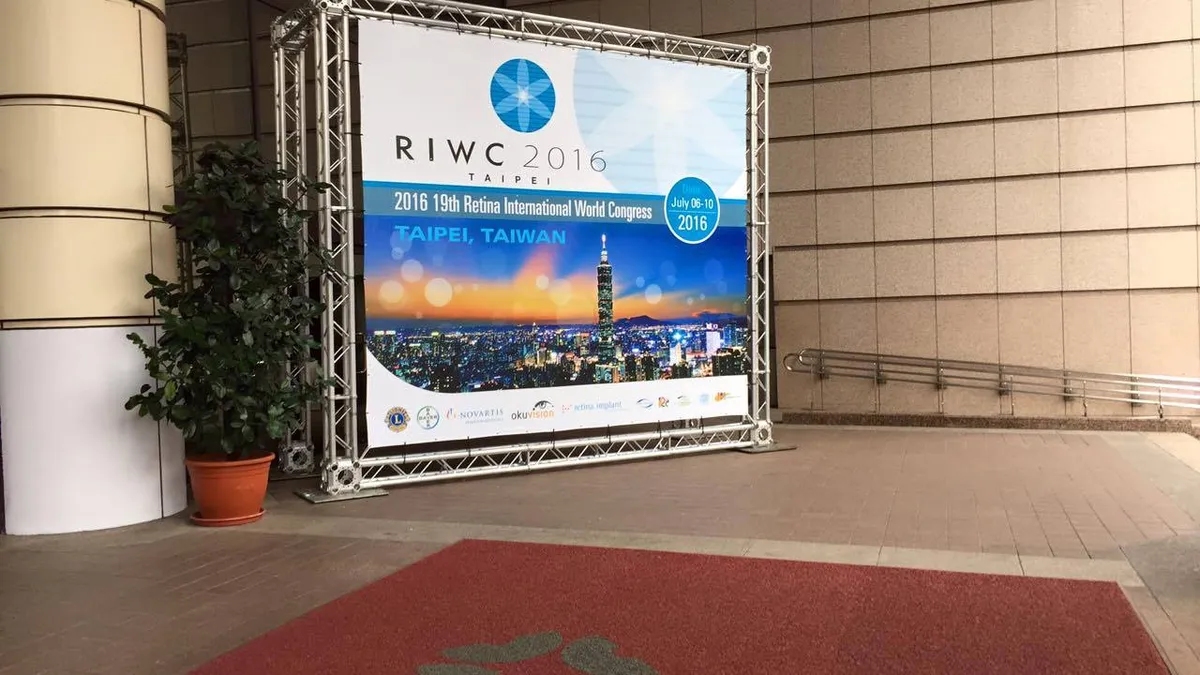
Eve of Registration
2025 Update: It is not recommended that every RP patient takes high-dose Vitamin A as stated in this 2016 message. The underlying genetic causes vary among RP patients and should not be generalized.
After joining the Taiwan Retinitis Pigmentosa Association, I was fortunate to learn that this year's Retinitis Pigmentosa International Conference would be held in Taiwan. However, when I looked at the registration fee in early March, it was over NT$5,000, and with my national medical licensing exam approaching, I was not particularly keen on attending.
In early June, a senior from the National Cheng Kung University (NCKU) medical department—part of my extended school family and currently in the ophthalmology department at Taipei Veterans General Hospital—somehow learned about my eye condition and specially reached out via Facebook to share the conference information. Clicking into the registration page again, I realized that if I registered as a student and skipped the banquet, it would only cost around NT$1,500. I decided to register on the spot. The registration system was unique, dividing participants into three simple categories: students, patients and families, and scholars/professors. While discussing this with Professor Ching, who is leading the Usher Syndrome genetic research project, she made a point that deeply moved me: technically speaking, I simultaneously hold all three identities within the registration system.
Scene at the Conference
Due to a typhoon, I could not attend the continuing education session on Friday, so I only participated in the formal conference held at the Taipei International Convention Center on Saturday. Since most participating scholars presented in English, wireless headsets were distributed on-site with simultaneous interpretation provided. However, after switching to the interpretation channel and listening for a while, I found that the translation often made it hard to connect with the presenters' report content. I simply switched back to the original audio channel and turned up the volume. Fortunately, my English listening comprehension is decent; by focusing closely and following the PPTs, I could understand 70-80% of the content.
However, this conference was quite different from typical academic conferences, which are mostly aimed at researchers. Because it involved advancements in current therapies, this conference was open to patients and their families. As a result of the entire event being in English, many could not understand some of the highly specialized sessions, leading to a somewhat noisy and chaotic atmosphere.
Key Conference Highlights
Most of the sessions covered research on Retinitis Pigmentosa, the development of retinal implants, and some summaries on genetic sequencing. Since my main focus was on the ocular aspects of Usher Syndrome, here are my selected notes:
- Studies have shown that Lutein and Vitamin A can delay progression.
- The Prostaglandin derivative unoprostone isopropyl showed significant differences in Phase 2 clinical trials, but failed to reach statistical significance in Phase 3.
- Among retinal implants currently in development, the more successful ones can restore vision enough to recognize text and faces after implantation, but their function begins to degrade after just over a year.
- Regarding the genes for Retinitis Pigmentosa, over 200 related genes have currently been identified. Even the same gene can present with different phenotypes. Under the multiple effects of genotype and various environmental factors, the disease's progression and prognosis vary greatly.
- Regarding the current progress in stem cell therapy, retinal cells have been successfully cultured from pluripotent stem cells. The next goal is to culture a complete retina for testing in mice.
Professor Ching, who researches human genetics and also attended the event, believed that due to genetic variability, unoprostone isopropyl might originally have been effective for some patients, but once the sample size increased, the effect was diluted by patients with different genotypes who showed less response.
Additionally, Retinitis Pigmentosa is not actually a very precise pathological definition, leading to many different disease phenotypes subsequently being lumped into this miscellaneous category.
For further information, one could consult the co-organizing Taiwan Retinitis Pigmentosa Association, which collaborates with organizations in China, Hong Kong, and abroad, and periodically exchanges information on genetic testing and drug research progress.
Appendix: Therapeutic efficacy of topical unoprostone isopropyl in retinitis pigmentosa Study Shows Vitamin A slows down Retinitis Pigmentosa 台灣視網膜色素病變協會
Final Acknowledgments
Thanks to Professor Ching, who attended the event together that day, and the senior from the NCKU medical department who passed on the conference information.